
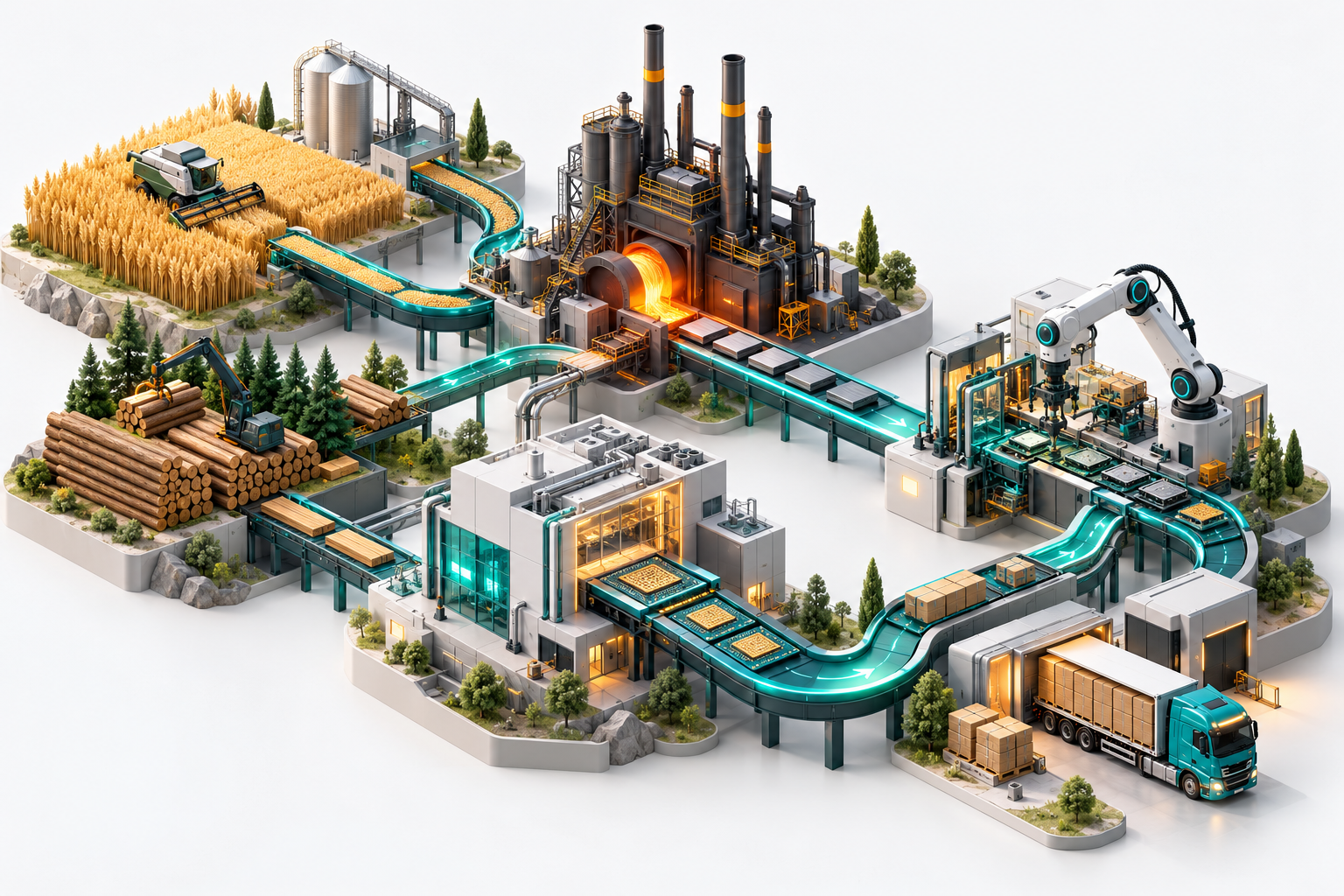
Build a network, not just a counter
Production — The Idle Game turns incremental progression into a supply-chain problem. Players begin with primary resources and expand toward increasingly complex products, connecting extraction, processing, manufacturing and distribution into an industrial enterprise.
The documented catalog spans 12 sectors, 96 facilities and commodities, and eight tiers. Higher-tier production consumes lower-tier stockpiles, so growth depends on balancing the whole network rather than simply buying the most expensive available upgrade.
Operational choices shape the factory
- Throttle individual facilities to manage resource use and upstream bottlenecks.
- Choose whether finished stock is sold through logistics or retained for downstream production and contracts.
- Inspect facility-level production rates, inventory changes and financial telemetry.
- Fulfil procurement tenders, allocate corporate reputation and pursue longer-term prestige progression.
- Switch between standard facility cards and a denser compact presentation.
A catalog-driven simulation
Sector definitions are organized as JavaScript modules. The Python backend reads the catalog at startup, keeping product definitions connected across the browser and server implementations. A directed acyclic graph describes dependencies between facilities and their inputs.
The repository includes engine tests and a graph validator intended to catch invalid dependencies, cycles and catalog inconsistencies. This makes the catalog architecture an important part of the project, beyond the visible game interface.
Persistence and progression
The README describes guest play with local persistence, optional accounts, savegame import/export and offline production calculations capped at eight hours. Longer-term systems include procurement relationships, reputation allocation and an IPO-style reset that unlocks persistent improvements.
These mechanics create two time scales: immediate decisions about stock and bottlenecks, and broader decisions about how to structure the next expansion. The game's own documentation remains the reference for the current balance and exact progression rules.
A compact web stack
The documented deployment uses Docker Compose, a FastAPI backend, SQLite storage and an Nginx frontend/reverse proxy. The browser client is built from JavaScript ES modules and CSS rather than a separate application framework.
The repository provides local startup instructions and configuration examples. This page describes the software rather than claiming a separately verified public game deployment. Its featured image is a conceptual supply-chain diorama, not an image of the actual interface.
Explore the repository
Read the source code and project documentation for the latest implementation details and setup instructions. This description is based on the public repository reviewed on October 29, 2026.